The Book of Record
What would accounting be without revenues or expenses? Eric taught us that revenues, expenses, liabilities, assets and owner's equity were simply "classifications," "views" or perspectives of business events that were of interest to the accountants. But other views of these business events exists that were equally valid for other users. By forcing the accounting view of the data on top of the data capture, other uses or views of the data are destroyed. He said there was an entirely different way the system could be constructed to report the same results. He argued that that approach would allow the system to do much more.
What does that mean? Let's start simple by continuing our example, by defining what "the data" is, or perhaps more descriptively, what the "book of record" is. The term "book of record" is used by accountants to define the most important part of the accounting system; that which is audited and found to be accurate in "all material respects." The choices for the book of record from our accounting system are:
Options one and two don't make a lot of sense; they are outputs from the book of record, not the book of record. Once the statements are produced they are static and don't change; they are not updated through the accounting cycle.Most accountants would define the General Ledger (the GL) as the book of record. It is the last step in the accounting cycle before the creation of the trial balance and financial statements. It is an ongoing part of the process.However, every balance in the GL has to be supported by journal entries. This then suggests that actually the journal entries could be the book of record. Instead of using the General Ledger as the source of producing the trial balance and the statements, it is possible to use the journal entries. But, to use the journal entries as the source of producing the trial balance and the statements, one would need to keep all the journal entries ever created and add them up to produce the trial balance as of a point in time.Make no mistake; this isn't an easy thing to do. In our personal financial example, if some portion of the cash you have on hand was earned on your first summer job, you would need to have journal entries for it and all the other receipts and expenditures since then to calculate your cash balance today.That seems a bit unrealistic. But if it were possible, would there be benefits? Does that system do more? Would it allow other "perspectives" or "views" of the financial information as Eric suggested?
- The information on the balance sheet and income statement,
- The information on the trial balance,
- The rows in the General Ledger, or
- The journal entries.
Flexible Income Statements
One thing it would enable is creation of income statements for any period of time, eliminating the need for the closing entries. By using the general ledger, an income statement can be produced every day in April, the balances would always start from the first day of the month.For example, if we wanted our accountant to give us an income statement for an odd period, say April 16th through May 5th, she couldn't use the GL for the income statement balances. Ignoring the closing entry, the following journal entries show that the salary revenue for that period should be $2,243.65. Figure 14. Salary Revenue Account Journal Entries
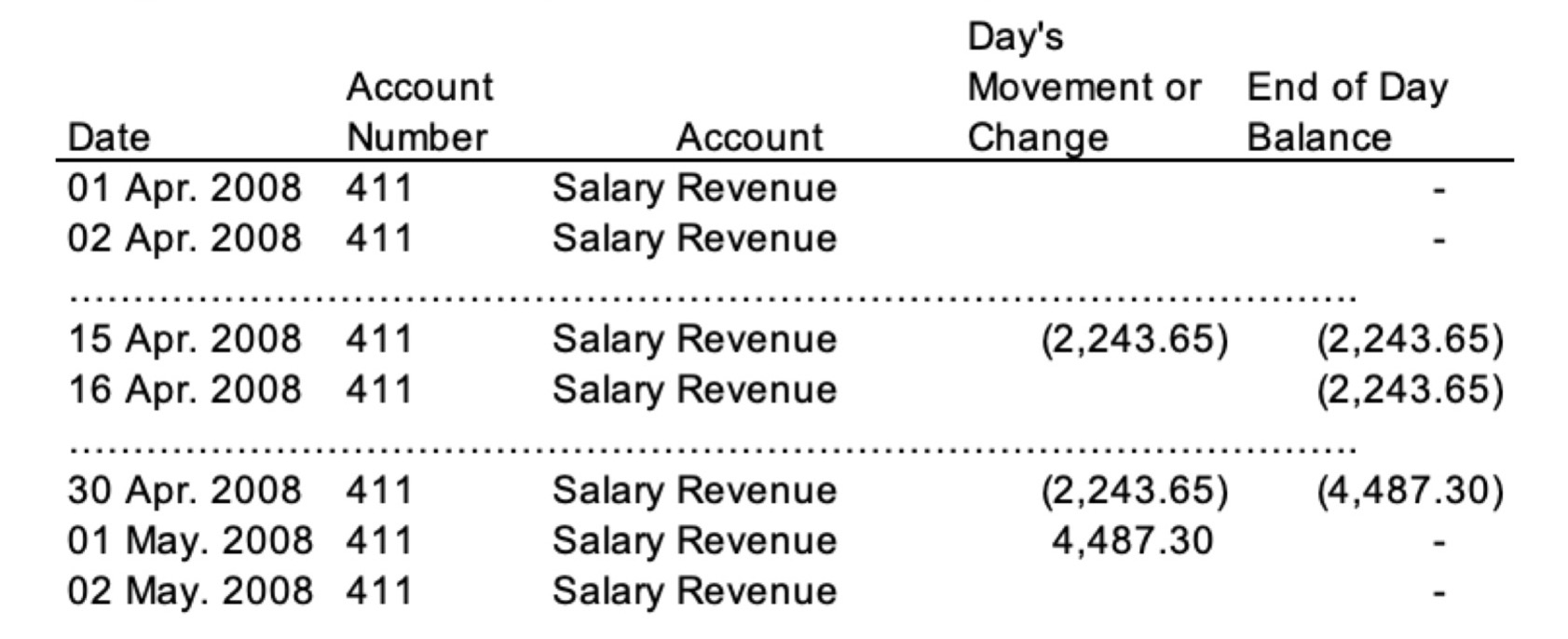 Figure 15. Ledger Balances for Salary Revenue Account for April
If we produced the income statement by adding up the journal entries within the date range, rather than from the GL, we could produce this and any other income statement.
Events
The "E" in REA Theory stands for "Event". The idea behind the theory is that events, business events, provide the basis for business reporting. A business event is anything the business wants to plan, execute, control, or evaluate. For example, in our personal financial world, being paid our salary is an event we would likely want to plan, execute by seeing that we actually get paid, control where the money is deposited, and evaluate any deductions taken out such as taxes when we do our income taxes.It is likely that every journal entry made in our personal financial system is an event; we wouldn't have taken the time to make a journal entry of it if we didn't want to plan, execute, control or evaluate it. Thinking of the journal entries as events helps to understand the theory. Events are sometimes more commonly called transactions.Transactions Versus Balances
This difference, between viewing the GL or the journal entries as the book of record highlights a key contrast in the approach to financial reporting: the difference between transactions and balances. Balances tend to be a point in time picture, much like the balance sheet. The GL shows the balance for each account after the posting process. The GL balances are immediately informative; there is no calculation to be done to make them useful. However, they aren't very flexible; they are mostly useful for the information they contain at that moment.Transactions aren't as informative. They can be used as building blocks and combined in many ways to present information. But, they have to be added up to form balances before they become interesting.1To show this graphically, the following are the transactions - the offset side of the journal entries - affecting the credit card payable account.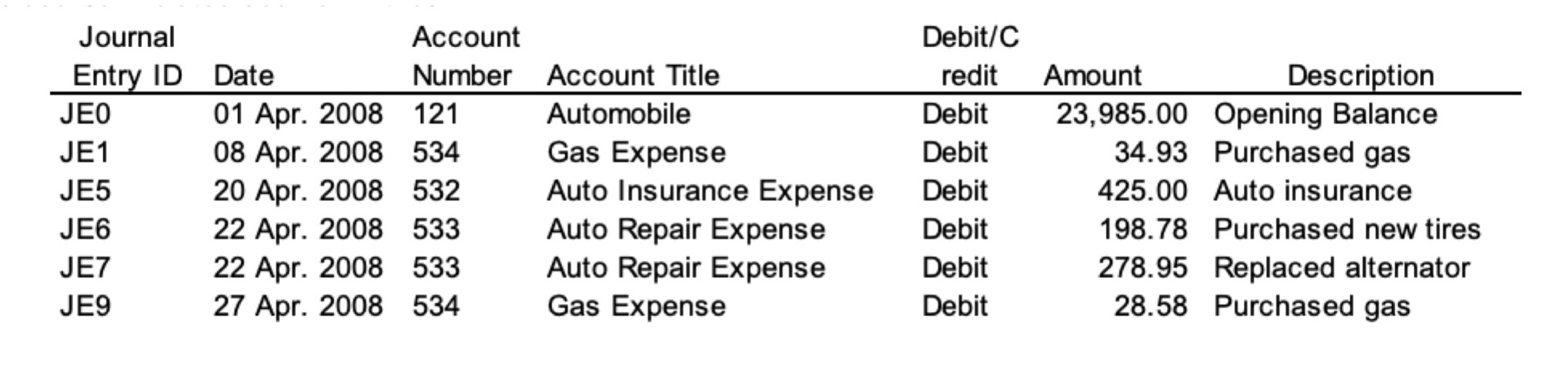 Figure 16. Single Side of Credit Card Payable Account Journal Entries
The following are the resulting balances at the end of each day from posting these transactions to the General Ledger Credit Card Payable Account Balance:
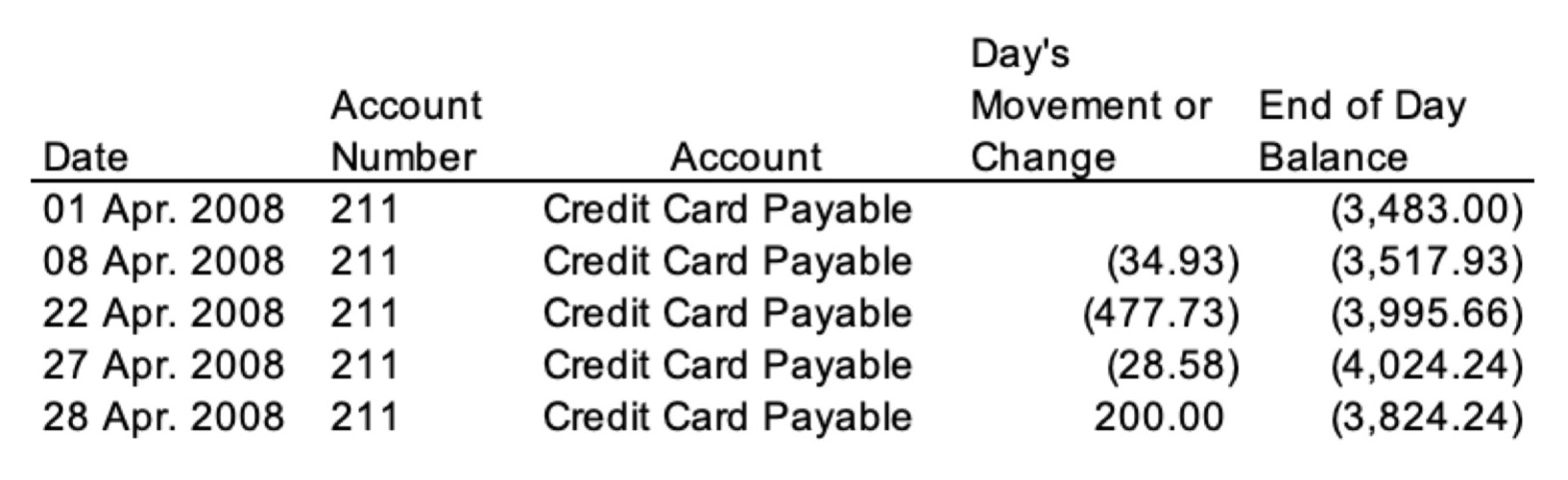 Figure 17. Credit Card Payable Account General Ledger Balances
What do the general ledger balances tell us? We can see the date, the account number and name, the day's change in the balance, sometimes called the movement, and the balance at the end of the day.
Additional Attributes
Thus far in our financial system, we have been interested in one category of "things" called account. In our little financial example, there isn't much question about the "who" is involved. We have assumed that our financial system is just for us as an individual, but business financial systems aren't just for one person. A business is most often composed of groups of people, and the system has to produce reports for these groups. In business, the "who" is very important and a lot of work goes into keeping track of it all. Let's extend our example financial system in perhaps a bit of a farfetched way to show how this impacts the system, and how this can cause balances to become transactions if approached in a particular way.Let's assume that our financial system is for our family, which is composed of more than one person. Each family member in our little system might use some ID, like a social security number, to record on the journal entries which ones are theirs. In our example, as in many traditional financial systems, a concept of a cost center is used to track the "who".2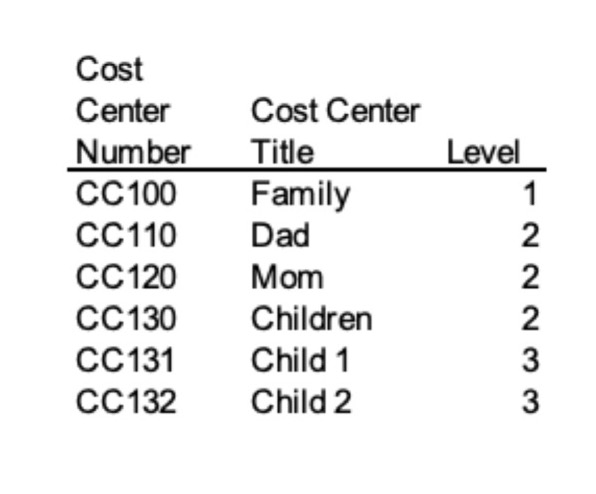 Figure 16. List of Cost Centers
This cost center simply becomes another column on the journal entries containing numbers similar to the Account column. This column would also be added to the General Ledger. Thus when we post entries, we post them to a combination of account and cost center. At any point in time we can find what the balance is for a particular account for a particular cost center by looking in the general ledger. We can then produce a trial balance which is summarized by cost center as well as by account. Using these pieces of information, we can then produce financial statements for each person.
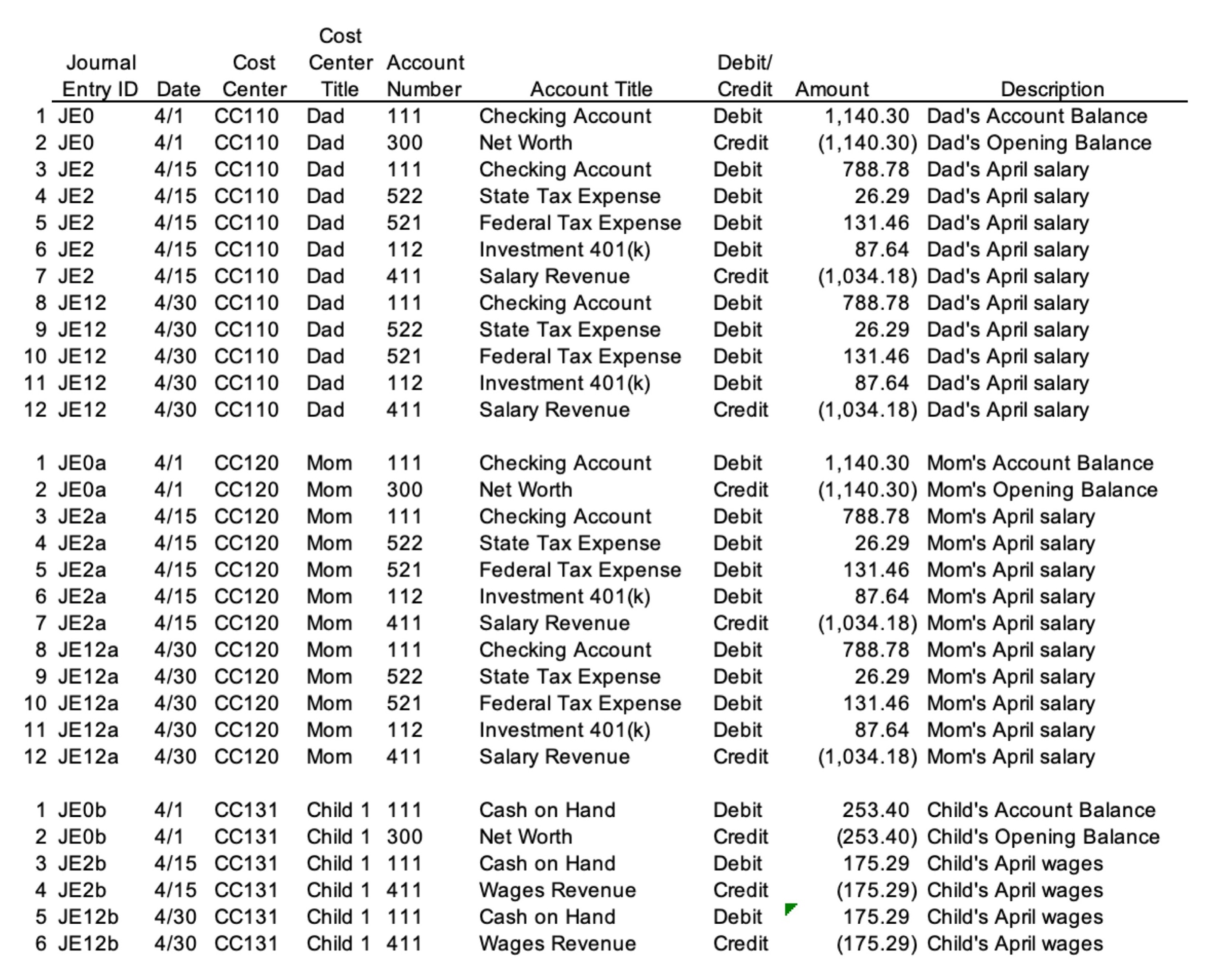 Figure 19. Cost Center Journal Entries
When we make a trial balance from a ledger that includes cost center as a posted element (a column), it would look like this:
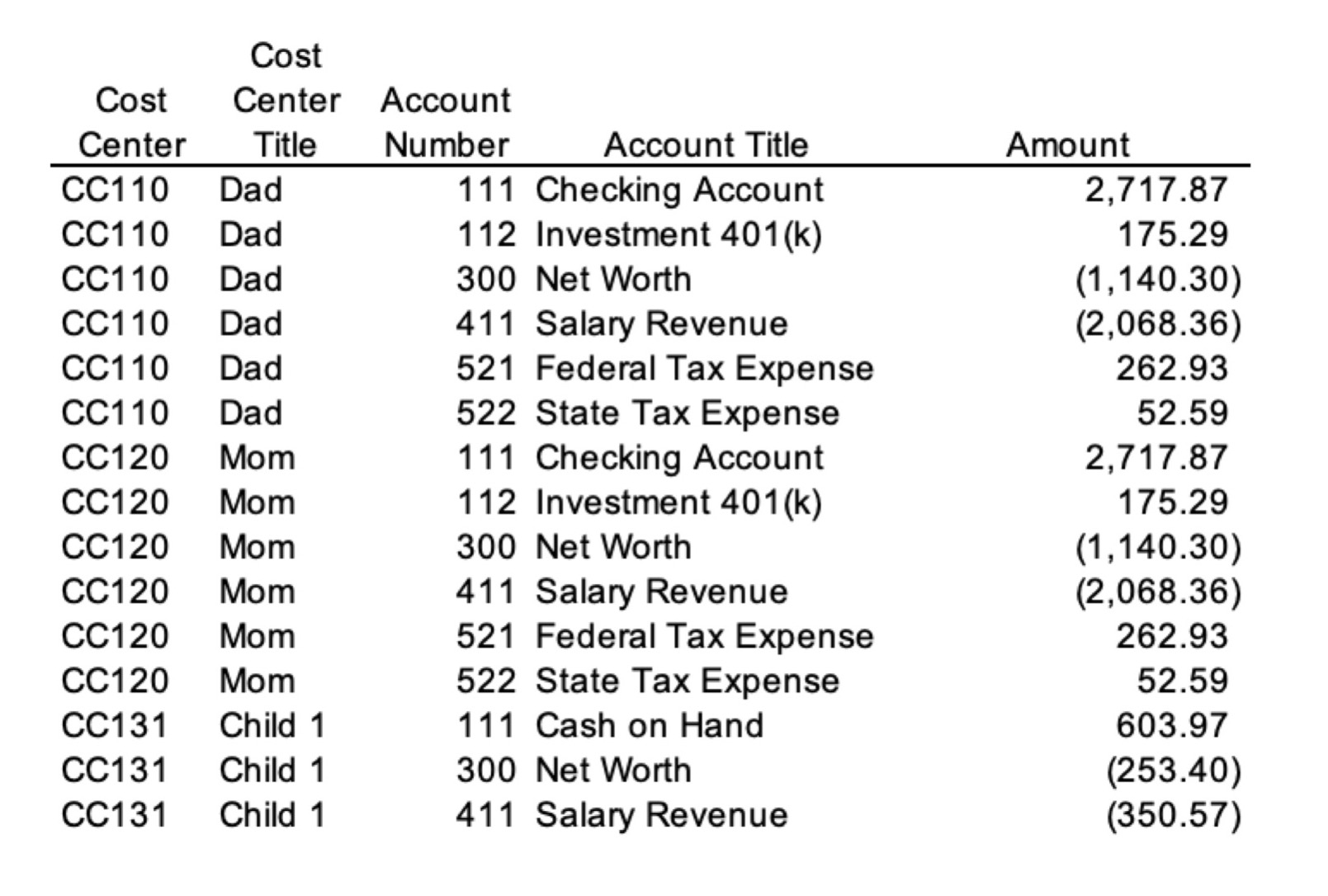 Figure 20. Cost Center Trial Balance
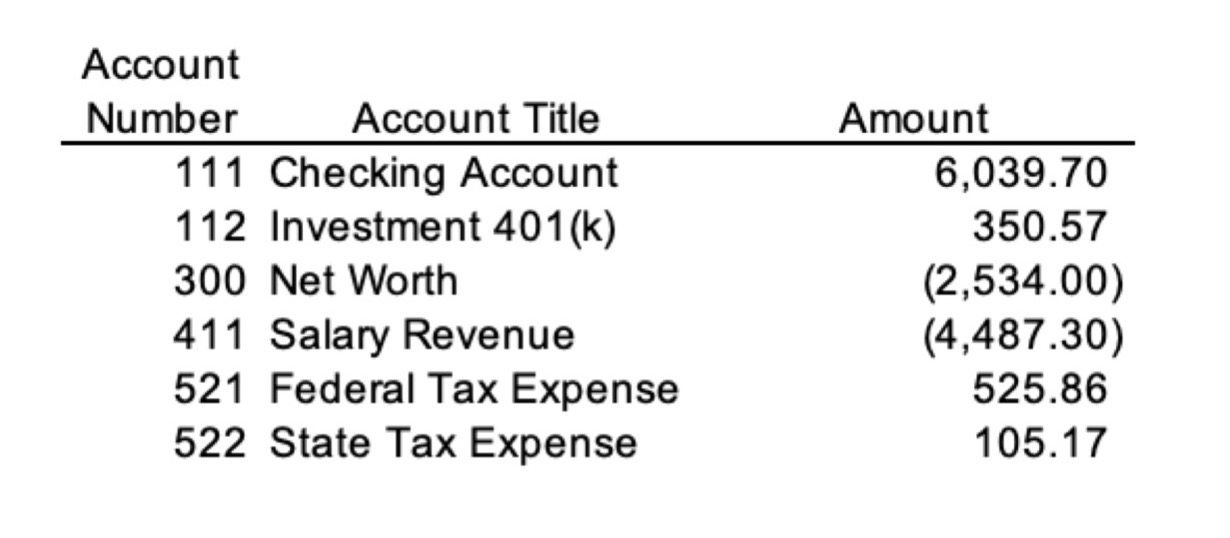 Figure 21. Summarized Cost Center Trial Balance
Automation
Actually, a third approach is also available. We could add up each of the detailed journal entries, which includes cost center, and create both trial balances, by simply ignoring the cost center value when making the second trial balance. This can be done because we have computers. Eric started to intertwine accounting and my computer classes, and show they had a closer relationship than I had realized.Adding up all the detailed journal entries each time a report is to be produced would be far too expensive if done manually. In a manual system, the investment in arithmetic has to be retained to produce the next period's report. Balances store this investment; transactions do not. Debits and credits were invented because people are error prone when doing math. They check that the investment made in math today has value tomorrow. However, the low cost and consistent accuracy of computing can make retaining this investment unnecessary, simplifying the entire system. This is at the heart of the whole matter Eric was trying to teach us. Computers make it possible to use transactions with more information on them to produce multiple outputs in a more flexible manner.
Additional options are available for a definition of the book of record besides just the GL or the double-entry journal entries. A different set of "journal entries" could also be considered the book of record. But now we start to depart from the standard process of accounting.
1 A much smaller set of reports are produced with listings of transactions without any modification.
2 Note that a hierarchy can be applied to the cost center table, the same as with the account table.
3 Note that the child's account title is "Cash on Hand" but the consolidated Account Title is Checking account. This system allows defining local accounts titles for individual financial statements different from the consolidated accounts.
4 An additional approach would be to use a reporting hierarchy. The net effect of this approach isn't a great deal different than the option of creating the additional entries or another ledger. It is just that these "created entries" using the hierarchy only exist long enough to be used on the report. They may never be actually stored anywhere. But the processing of "rolling up a hierarchy" creates them nonetheless.
5 Note that the bottom three rows are exactly the same amounts as in the original Figure 11. The top three rows are not the same amounts because they are affected by other entries not included in the subset of entries in this cost center example. If all the journal entries had been used in the example, the trial balance would be exactly the same as that shown in the Sample Trial Balance.